Nanothermometry: measuring the heat of irradiated plasmonic nanoparticles
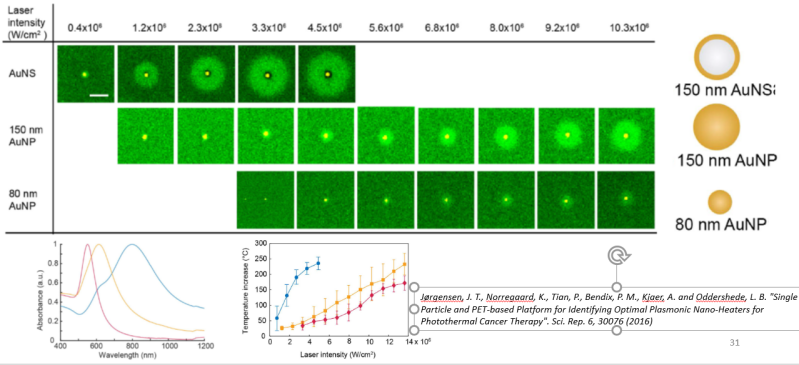
Using lipid membranes as molecular thermometers to visualize and quantify heat generated by individual nanoparticles.
How hot does a single nanoparticle become when illuminated by a laser? Measuring temperature at the nanoscale is challenging, yet essential for understanding how light interacts with matter and for developing applications in nanotechnology and biomedicine.
At BendixLab, we developed an innovative nanothermometry approach that uses lipid bilayers as temperature-sensitive matrices. Lipid membranes undergo a well-defined phase transition from an ordered (gel) state to a disordered (fluid) state at a characteristic temperature. By incorporating fluorescent lipid probes that preferentially partition into the different phases, we can directly visualize the local melting of the membrane surrounding an optically heated nanoparticle.
The boundary between the gel and fluid phases acts as a microscopic thermometer: its position identifies where the membrane reaches its transition temperature. By analyzing the spatial extent of the melted region, we can quantify local temperature gradients and determine the heat generated by individual nanoparticles.
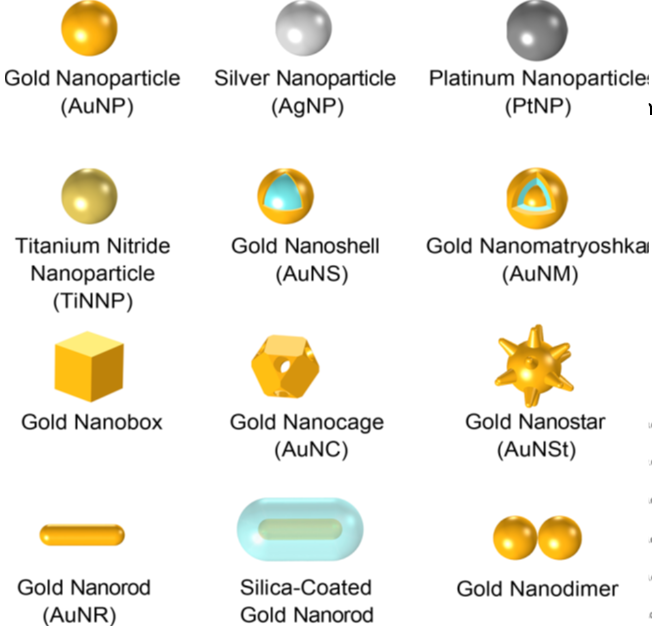
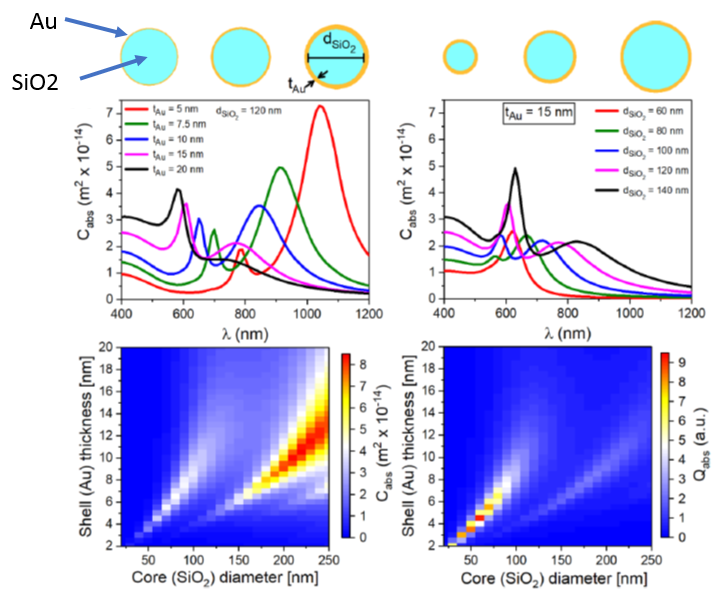
Using this approach, we have investigated laser-induced heating of plasmonic nanoparticles with different sizes, shapes and optical properties, including gold nanospheres and nanorods. Our experiments reveal how efficiently individual nanoparticles convert light into heat and how their geometry and optical excitation determine the resulting temperature distribution.
These studies have contributed to our understanding of thermoplasmonics, as reviewed in our Chemical Reviews article, Plasmonic Heating of Nanostructures (2019).
Beyond measuring nanoscale temperatures, our research has helped establish plasmonic nanoparticles as controllable nanoscale heat sources. By combining precisely localized optical heating with fluorescence microscopy, we can manipulate membrane phase behavior, investigate thermally induced changes in biological materials, and develop new approaches for cellular manipulation and membrane engineering.
Our research connects nanoscale heat transfer, soft-matter physics and membrane biophysics, turning lipid membranes into quantitative tools for exploring and controlling temperature at the nanoscale.
Selected publications
-
Bendix et al., Direct Measurements of Heating by Electromagnetically Trapped Gold Nanoparticles on Supported Lipid Bilayers. ACS Nano (2010). https://doi.org/10.1021/nn901751w
-
Kyrsting et al., Heat Profiling of Three-Dimensionally Optically Trapped Gold Nanoparticles Using Vesicle Cargo Release. Nano Letters (2011). https://doi.org/10.1021/nl104280c
-
Ma et al., Large-Scale Orientation Dependent Heating from a Single Irradiated Gold Nanorod. Nano Letters (2012). https://doi.org/10.1021/nl3010918
-
Jauffred et al., Plasmonic Heating of Nanostructures. Chemical Reviews (2019). https://doi.org/10.1021/acs.chemrev.8b00738