Membrane Curvature and Spontaneous Curvature
We investigate how membrane curvature, tension and lipid organization control protein sorting and membrane shape. Our goal is to connect the molecular composition of biological membranes with their measurable mechanical properties.
Using optical tweezers and fluorescence microscopy, we pull membrane nanotubes from vesicles and cell-derived membranes. These experiments allow us to quantify membrane forces and follow the redistribution of proteins between differently curved membrane regions.
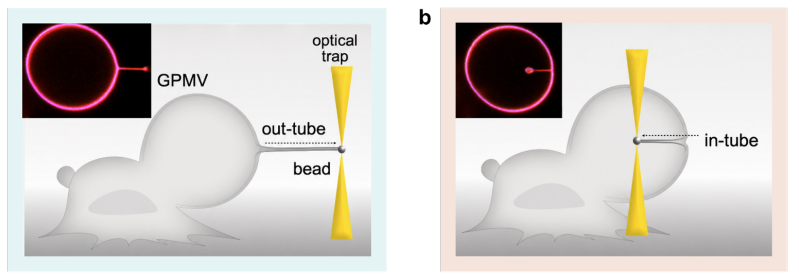
A recent direction combines inward and outward tether pulling with simulations to measure effective spontaneous curvature in complex membranes (see figure). We also investigate how membrane-bound proteins, including annexins, alter membrane shape and respond to curvature.
By combining controlled membrane deformation with quantitative imaging, we aim to distinguish proteins that preferentially occupy curved membranes from proteins that actively generate curvature.
Spontaneous curvature of cell membranes:
https://doi.org/10.64898/2026.07.31.742037 bioRxiv (2026). [preprint] Geiger et al.
Reviews on membrane curvature:
Review: Emerging Topics in Life sci. (2023) Ruhoff et al.
Review: BioChemical Society Trans. (2023), Ruhoff et al.
Curvature sorting and generation of annexins:
Soft Matter (2021) Florentsen et al.
ACS Nano (2019) Moreno-Pescador
Membrane curvature and GPCRs:
ACS Central Science (2020), Larsen et al.
Nature Chemical Biology (2017), Rosholm et al.
Membrane curvature sorting of I-BAR:
Soft Matter (2015), Barooji et al.
Membrane curvature sorting of F-BAR:
Sci. Rep. (2013), Ramesh et al.