Optical trapping of nanostructures
Quantifying Light–Matter Interactions at the Nanoscale
Using laser light to manipulate individual nanoparticles and measure the optical forces acting on them.
Can a single nanoparticle be captured and manipulated using light? How do its size, shape and material composition determine the forces exerted by a focused laser beam?
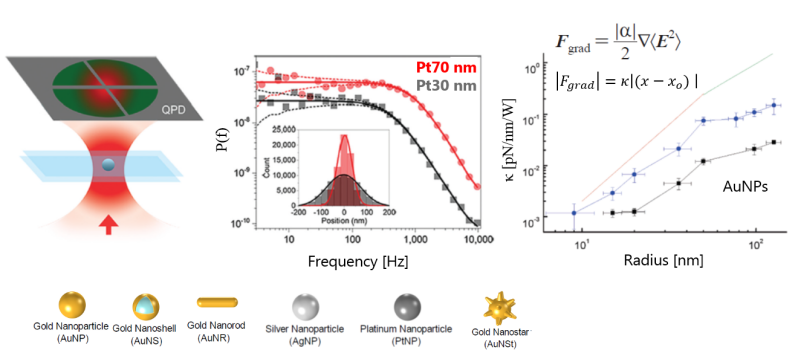
At BendixLab, we have pioneered the optical trapping and quantitative characterization of individual metallic nanoparticles. In our early work, we demonstrated stable three-dimensional optical trapping of spherical gold nanoparticles ranging from just 18 to 254 nm in diameter, establishing how optical trapping strength depends on nanoparticle size.
We subsequently investigated more complex nanostructures, including gold nanorods and gold nanoshells, whose optical properties are strongly influenced by their geometry and plasmonic resonances. These studies explored how nanoparticle shape, orientation and material composition govern interactions with focused light. Our research also extended beyond gold to strongly absorbing platinum, copper and titanium nanoparticles, revealing how different metals interact with optical fields.
A central contribution of our work has been the quantitative determination of optical trapping potentials and forces. By recording the Brownian fluctuations of individual trapped nanoparticles with high temporal and spatial resolution, we determine the optical trap stiffness and characterize the confining potentials. Combined with electromagnetic modeling, these measurements provide fundamental insight into nanoparticle polarizability, optical gradient forces, radiation pressure and light-induced heating.
Our studies have demonstrated how the competition between optical forces, scattering and absorption determines whether a nanoparticle can be stably confined and manipulated. This quantitative understanding provides a foundation for nanoscale manipulation, controlled photothermal heating, nanothermometry and the application of optically controlled nanoparticles in biological systems.
Selected Publications
1. Hansen (Bendix) et al. (2005). Expanding the Optical Trapping Range of Gold Nanoparticles. Nano Letters. DOI: 10.1021/nl051289r
2. Bendix et al. (2014). Optical Trapping of Nanoparticles and Quantum Dots. IEEE Journal of Selected Topics in Quantum Electronics. DOI: 10.1109/JSTQE.2013.2287094
3. Samadi, Bendix & Oddershede (2017). Optical Manipulation of Individual Strongly Absorbing Platinum Nanoparticles. Nanoscale. DOI: 10.1039/C7NR07374G
4. Ma et al. (2014). Heat Generation by Irradiated Complex Composite Nanostructures. Nano Letters. DOI: 10.1021/nl403798j