Membrane Curvature – How Membrane Shape Controls Protein Organization and Function
Can the shape of a cell membrane determine where proteins accumulate and how they function?
Cell membranes are continuously bent, stretched and reshaped during essential biological processes such as endocytosis, cell migration, vesicle trafficking and membrane repair. These deformations generate membrane curvatures on the nanometer scale, comparable to the dimensions of individual proteins. Membrane curvature is therefore not merely a consequence of cellular activity but can also act as a physical cue that regulates protein organization and potentially biological signaling.
At BendixLab, we investigate how proteins generate, sense and respond to membrane curvature, and how the interplay between membrane geometry, lipid composition and mechanical forces controls cellular function.
Creating and Measuring Nanoscale Membrane Curvature
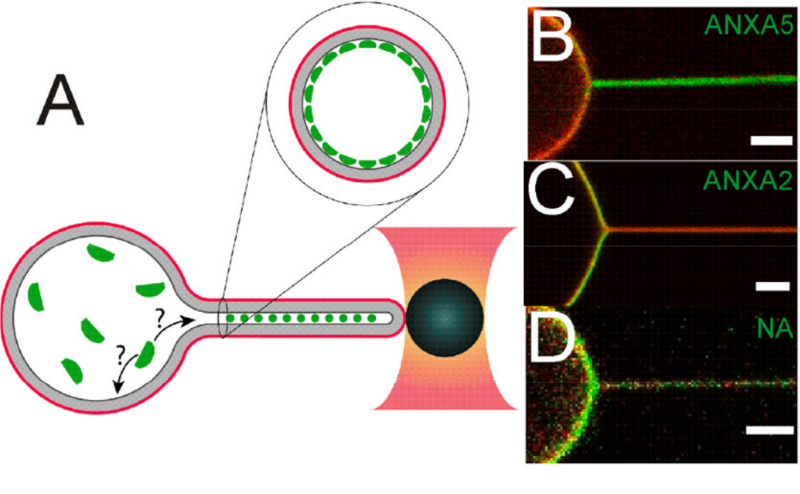
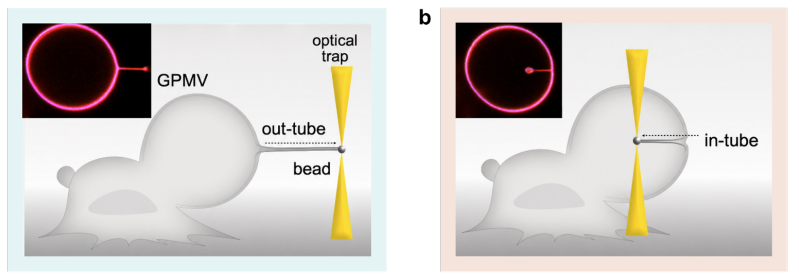
Using optical tweezers combined with advanced fluorescence microscopy, we pull thin membrane nanotubes from living cells, giant unilamellar vesicles (GUVs) and cell-derived giant plasma membrane vesicles (GPMVs). These nanotubes provide a controlled platform for studying membrane curvature at length scales comparable to individual membrane proteins.
By simultaneously measuring mechanical forces and the spatial distribution of fluorescently labeled proteins, we quantify how membrane curvature influences protein recruitment, sorting and membrane mechanics.
A particular focus of our recent research is spontaneous membrane curvature — the intrinsic tendency of a membrane to bend in a preferred direction. Using a novel dual-direction membrane tether-pulling approach, where nanotubes are pulled both inward and outward, we can quantify effective spontaneous curvature in complex biological membranes and investigate how proteins and membrane composition influence this fundamental physical property.
How Membrane Curvature Sorts Proteins
Our research has demonstrated that membrane curvature can strongly influence the localization of both peripheral and transmembrane proteins.
We have shown that G-protein-coupled receptors (GPCRs) exhibit curvature-dependent sorting in living cells, and that their response to curvature can depend on ligand binding. We have also demonstrated pronounced curvature sensing by annexins, a family of proteins involved in membrane remodeling and repair. In particular, annexin A5 can become enriched more than tenfold in highly curved membrane nanotubes.
Together with collaborators, we have further demonstrated that protein recruitment depends not only on the magnitude of mean membrane curvature but also on membrane geometry, including Gaussian curvature.
From Curvature Sensing to Curvature-Dependent Signaling
An emerging direction in our research is to understand whether membrane curvature can do more than redistribute proteins: can membrane shape directly influence the conformational state and activation of transmembrane receptors?
We investigate how nanoscale curvature, membrane asymmetry and local membrane mechanics may alter the energetic landscape of membrane proteins, particularly GPCRs. By combining controlled membrane deformation, quantitative force measurements and fluorescence-based activation sensors, we aim to uncover how physical changes in the lipid bilayer can influence cellular signaling.
Our ultimate goal is to establish a quantitative physical understanding of how membrane shape and protein function are coupled — connecting membrane biophysics with mechanobiology, cell signaling and membrane repair.
Selected Publications
-
Geiger et al. (2026). Insights into Spontaneous Curvature in Complex Membranes from Dual-Tether Pulling Experiments. bioRxiv (preprint).
DOI: https://doi.org/10.64898/2026.07.31.742037 -
Ruhoff, Bendix & Pezeshkian (2023). Close, but not too close: a mesoscopic description of (a)symmetry and membrane shaping mechanisms. Emerging Topics in Life Sciences.
DOI: https://doi.org/10.1042/ETLS20220078 - Review: BioChemical Society Trans. (2023), Ruhoff et al.
-
Florentsen et al. (2021). Annexin A4 trimers are recruited by high membrane curvatures in giant plasma membrane vesicles. Soft Matter.
DOI: https://doi.org/10.1039/D0SM00241K -
Larsen et al. (2020). How Membrane Geometry Regulates Protein Sorting Independently of Mean Curvature. ACS Central Science.
DOI: https://doi.org/10.1021/acscentsci.0c00419 -
Moreno-Pescador et al. (2019). Curvature- and Phase-Induced Protein Sorting Quantified in Transfected Cell-Derived Giant Vesicles. ACS Nano.
DOI: https://doi.org/10.1021/acsnano.9b01052 -
Rosholm et al. (2017). Membrane curvature regulates ligand-specific membrane sorting of GPCRs in living cells. Nature Chemical Biology.
DOI: https://doi.org/10.1038/nchembio.2372 - Dynamics of membrane nanotubes coated with I-BAR. Soft Matter (2015), Barooji et al.
- FBAR Syndapin 1 recognizes and stabilizes highly curved tubular membranes in a concentration dependent manner. Sci. Rep. (2013),